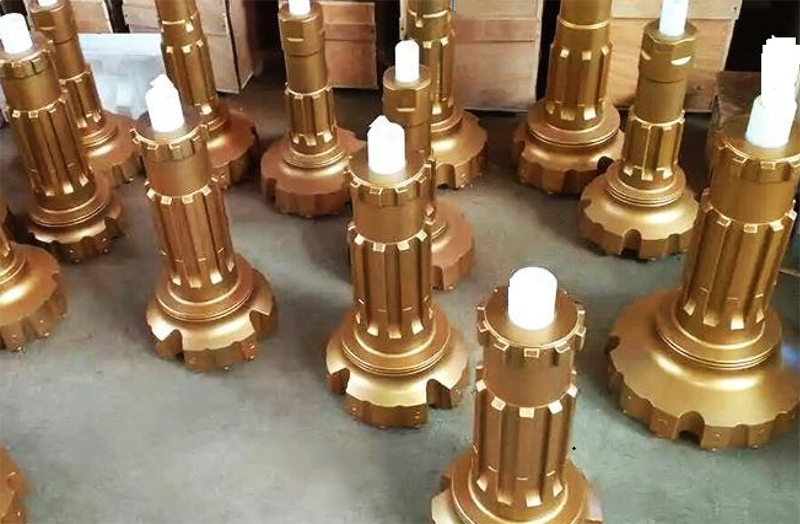
Potential hole drill is mainly used in open pit mining, construction foundation excavation, water conservancy, power station, building materials, communications, national defense construction in a variety of drilling work.Compared with common rock drill bits, it has the characteristics of drilling depth, large diameter, high drilling efficiency and wide range of adaptability.At present, the potential hole drill in the domestic drilling industry occupies an important position.Because of high wind pressure, the alloy teeth bear a large impact energy, the quality of the alloy teeth put forward a very high demand, at the same time, the choice of alloy teeth is also very critical.We further cooperated with the cemented carbide factory to develop the cemented carbide with high wear resistance and high strength.By adjusting WC grain size and CO phase content, hard alloys with different strength, toughness and wear resistance can be obtained to meet different needs.Through the test, generally lower CO content and finer grain size make the hard alloy have higher wear resistance, while higher CO content and thicker grain size make the hard alloy have higher strength and toughness.At present, WC, the hard alloy material commonly used for rock drilling, has a grain size of 2 ~ 5 m and a CO content of 5% ~ 16%.A large number of practices have shown that the heterogeneity and anisotropy of rock occurrence, composition and fabric make it difficult to find two rocks with exactly the same composition and physical and mechanical properties.The physical and mechanical properties of different rocks are very different, so the correct choice of cemented carbide for rock drilling must consider the drilling mode, the working parameters of drilling equipment and the properties of rock.
Previous article: METHOD AND STEPS OF USING HANDHELD ROCK DRILL
Next article: Is the end